Certification Readiness
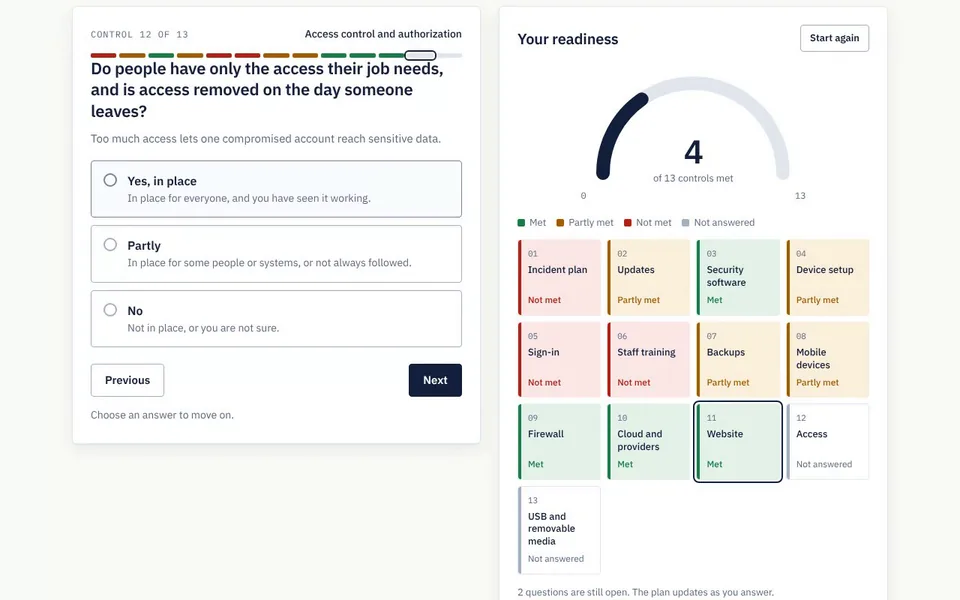
Security Readiness Check
Answer 13 questions on the Canadian baseline controls and watch the score, the top risks and a 30, 60 and 90 day plan build as you go.


Every system has a weak point. We find it, and we build the lever that secures it.
FlintLever is a security and compliance company, established in Canada and serving business around the world. We assess your office and plant networks, fix the weak points in order of risk, and help you prove your controls to customers, insurers and regulators.
Most security problems are not exotic. They are an unlisted device, a shared password, or a plant network that was never separated from the office. We find them, rank them and fix them in order.
Each line answers a different question: what must you prove, where are you exposed, who keeps watch, and how do you build systems that stay secure.
CyberSecure Canada, defence supplier readiness and customer security questionnaires.
IT and OT assessments, scored and ranked, with a fix plan you can act on.
Monitoring, email security, tested backups and a monthly report in plain language.
Secure-by-default software, the IT and OT data bridge, and FlintLever Private AI.
Each line lists typical engagements, what you get, and a demo. See all four service lines
Each demo is a working sample of the service, built around a fictional company. Try one yourself, or watch a one-minute walkthrough.
Answer 13 questions on the Canadian baseline controls and watch the score, the top risks and a 30, 60 and 90 day plan build as you go.
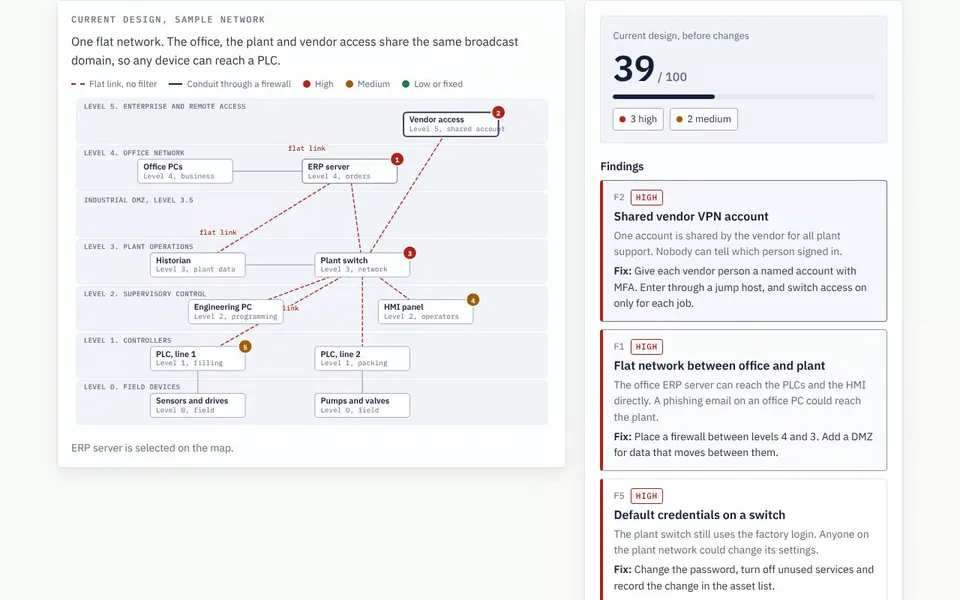
Explore a food plant's network, pick a finding to see where it sits, then compare the current design with the proposed zones.
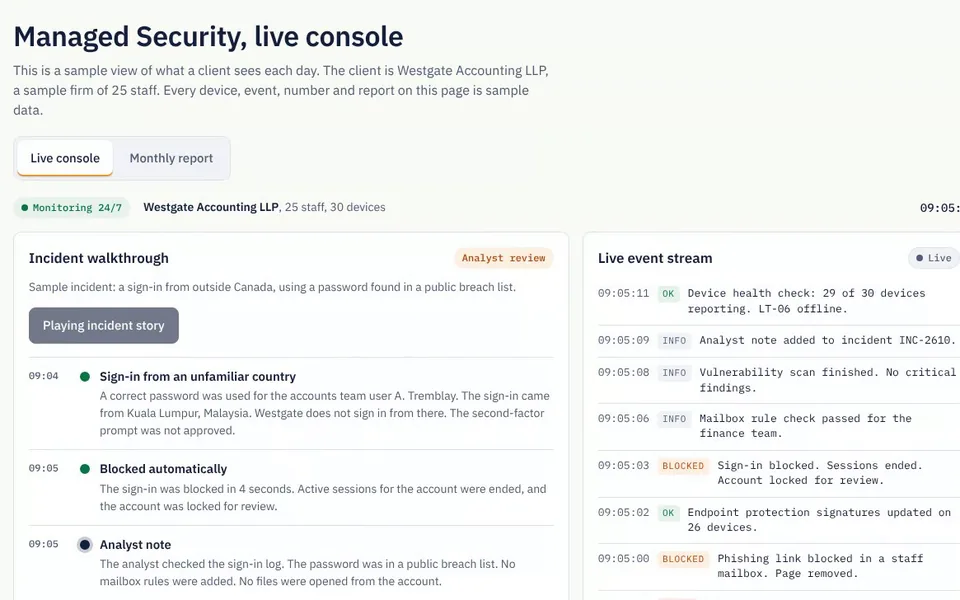
Follow a suspicious sign-in from the first alert to a closed case, with the live event stream and the monthly report.
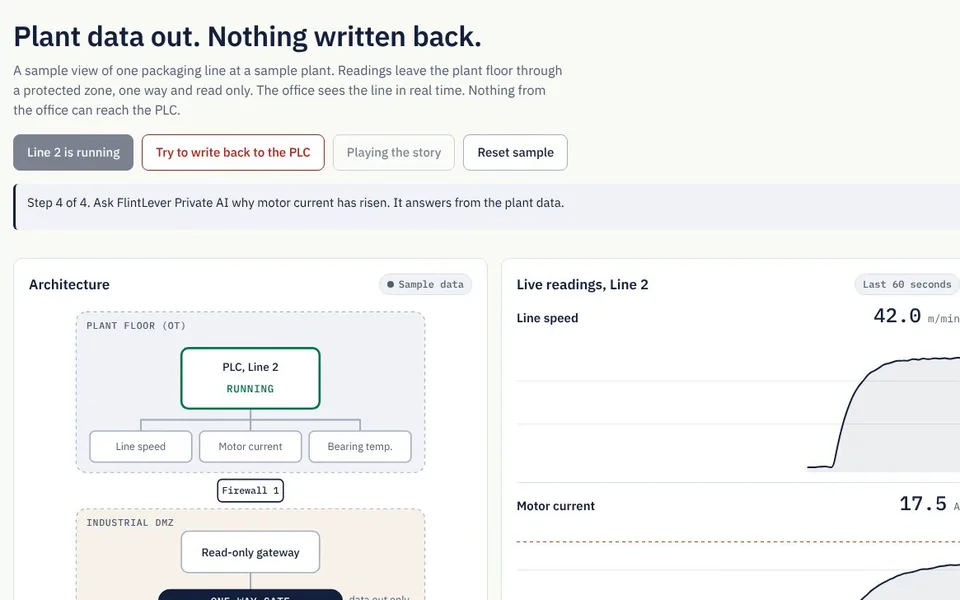
Start a packaging line and watch readings flow one way to the office. Try to write back to the PLC and see the gate stop it.
We work with companies that must show their security to someone else: a plant owner, a defence contract office, a client, an insurer or a public buyer. We work in four groups.
Plants with PLCs, SCADA and sensors that must keep running. We separate the plant from the office, and we make sure controls are safe to change.
Suppliers who must meet Canada's defence cyber certification to keep or win contracts. We prepare the Level 1 self-assessment and the evidence for Level 2.
Accounting and law firms, clinics, payment and financial companies, and insurance brokers that hold client data and must show their controls.
Companies that sell to governments and must answer security questionnaires and contract clauses. We answer them with evidence, not promises.
A private AI workspace for your staff, on a FlintLever server, shared or dedicated, or on your own premises. It is built with the same controls we ask of your other systems, and it is documented, so you can show an auditor where your data goes.
Summarize our incident response plan for the team.
Five steps: detect, contain, remove, recover and review. Each step names an owner. The plan is due for a tabletop test every twelve months.
Incident response plan 2026.pdfWrite a phishing awareness email for all staff.
Draft ready: three warning signs, what to do after a wrong click, and who to call. Short enough to read in a minute.
Every security engagement follows the same five steps, from the first check to a system that stays secure.
Map systems, plant and controls against the standard that applies
Rank each weak point by risk, plant safety and what you must prove
Make the changes in agreed windows, and test each one
Collect the evidence a customer, insurer or auditor asks for
Monitor, test backups and review monthly, so the fixes hold
CyberSecure Canada is the federal certification for small and medium-sized organizations. The Standards Council of Canada runs it. It certifies against CAN/DGSI 104, a National Standard of Canada that builds on the Canadian Centre for Cyber Security's baseline controls and sets requirements at two levels. An accredited certification body audits your organization against it, and the certification lasts two years. It gives customers, insurers and suppliers a checked answer to how you protect your systems.
Yes, with care. Plant work is planned with your plant team. We start with records, network diagrams and passive observation, without sending traffic to the machines. Anything that could change a controller is done only in an agreed window, after a backup, with the plant lead present. We do not reboot or patch a controller without that agreement.
You get a report with each finding ranked by risk, and a fix plan with owners and dates. We can make the fixes with you, or your IT provider can make them. We test the fixed items again, and we agree a schedule for checks after that. You keep the report and the plan.
No. We work with your IT provider. If they run your day-to-day IT, they keep doing it. We set the security requirements, check the work, and help them meet the controls your customers and insurers ask for. If you have no IT provider, we can help you choose one, or provide FlintLever Managed Security.
Mostly the Canadian Centre for Cyber Security baseline controls and CyberSecure Canada (CAN/DGSI 104). We also work to the NIST Cybersecurity Framework, IEC 62443 for industrial control systems, ISO/IEC 27001 for information security management, and the Canadian Program for Cyber Security Certification (CPCSC) for defence suppliers. We choose the standard that matches your customer, contract or plant.
No. An IT person or an IT provider is enough. You need one named person who owns security decisions, time from your IT provider, and, for plant work, time from your plant lead.
FlintLever Private AI answers everyday work with a private model on a FlintLever server or on your own server. When a bigger job uses a cloud model such as Claude, GPT or Gemini, the request goes through a routing service to a company that runs the model, which may be outside Canada. Each request asks for zero data retention, and training on your data is switched off. On the shared FlintLever server, if the private model is briefly unavailable, an everyday request with no personal details detected can be answered by a cloud model instead. A dedicated server or one on your premises never does this. We document where each piece of data goes and who can see it.
Send a few lines about your systems, your plant if you have one, and the customer request, deadline or concern behind it. We'll tell you honestly what we would check first, and whether you need a full assessment at all.